The three modes compared
| |
Boat |
Plane |
Helicopter |
| Time with the whales |
The most — a good 2 hours at sea in a 3.5-hour trip |
30 minutes in the air, timed to the whales’ surfacing rhythm |
45 or 60 minutes, part of it hovering over the whale, part at the mountain landing |
| Perspective |
Eye level — you float near the whale and see the blow and the fluke, but only the part above the surface |
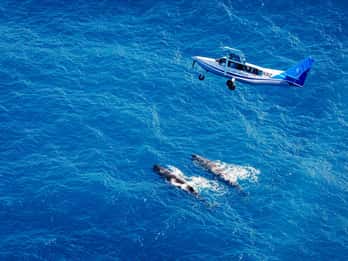
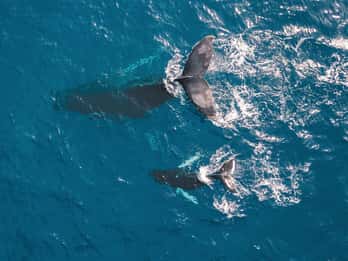
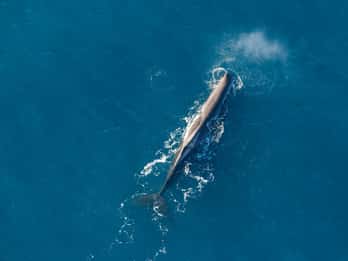
The whole animal in one frame, from blowhole to fluke — only the air shows a sperm whale at full length |
The same full-length view, plus the ability to hold position over a surfacing whale |
| Seasickness |
The real risk — the most common complaint in boat reviews, on a sea that is often rough |
None — you skip the swell entirely |
None — no swell under you |
| Weather window |
Cancelled in heavy swell, sometimes at short notice |
Needs flyable visibility; also cancelled at short notice |
Needs flyable weather; the mountain landing depends on conditions too |
| Group size |
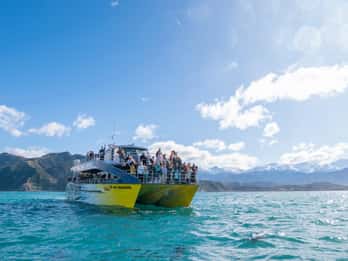
Large catamaran — you share the deck |
Max 6–7 passengers, window seat guaranteed |
Max 5 or 6 passengers, depending on the operator |
| Best for |
First-timers, families, anyone who wants time on the water |
Short-on-time visitors, sensitive stomachs, photographers who want the full silhouette |
Occasions, anyone who wants the hover and the landing |
The current price of every trip is in the tour cards above and the booking table below. Limits worth knowing: both planes carry a 120 kg per-person weight limit, South Pacific Helicopters’ 1-hour flight takes children from age 8 (for the other helicopter flights, see the product page), the boat from age 3 (weather permitting).
The boat: the most whale time, the roughest ride
The cruise is run by Whale Watch Kaikoura, the Māori-owned company (Ngāti Kuri, a hapū of Ngāi Tahu) that holds the only whale watching boat permit in Kaikōura — a business built by local families in the late 1980s that turned the town into the whale watching capital of New Zealand. You ride a catamaran fitted with engines designed to keep underwater noise low, with commentary on the canyon and its animals along the way. It is the trip with the most actual whale time (currently 4.6★ from 3,770 reviews).
The caveat: this stretch of the Pacific is often rough, and seasickness is the single most common complaint in the boat’s reviews — the operator itself flags it on the booking page and sells remedies at its office. The operator also advertises a partial refund if a cruise sees no whale; the binding terms live on its own channels, and that promise belongs to the boat alone — do not carry it over to the flights.
!
If you know you get seasick, believe the reviews.
The swell over the canyon is not a calm-bay cruise, and the trips run unless the weather is genuinely bad — which means plenty of rough-but-sailable days. Remedies help many people; the surer fix is to book a mode that skips the water entirely. That is exactly the niche the planes and the helicopter fill.
The plane: the whole whale, in 30 minutes
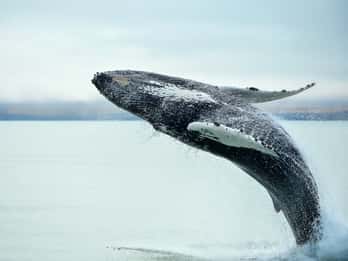
A sperm whale at the surface shows a boat perhaps a back and a blow, then a fluke on the dive. From the air you see the entire animal at once — the full silhouette hanging in the blue — and that view exists only from above. Two operators fly the canyon in small fixed-wing planes, so you can compare providers here: Wings Over Whales flies up to 6 passengers, Air Kaikoura up to 7 with pilot commentary, and both guarantee every passenger a window seat. Both carry a 120 kg per-person weight limit.
Two Air Kaikoura specifics worth knowing before you book: the operator states explicitly that there is no refund if no whale is sighted — the flight itself is the product — and departure times can shift around the whales’ dive cycles, because the pilots time their take-offs to meet a surfacing whale rather than an empty sea.
The helicopter: the hover and the mountain landing
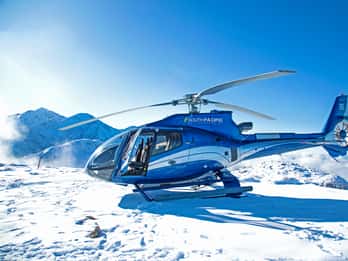
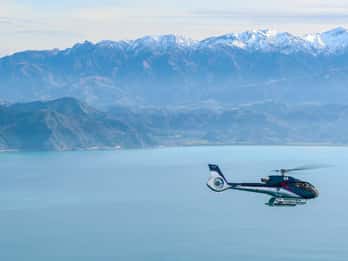
The helicopter does two things neither the boat nor the plane can. It holds position: when a whale surfaces, the pilot can stay over it instead of flying a pass. And it lands on the way home — on Mt Fyffe, the mountain behind the town, or in the Seaward Kaikōura Ranges, with the whole peninsula laid out below. Two operators fly the bookable options on this site. South Pacific Helicopters has a 45-minute and a one-hour flight, both with a mountain landing and up to 6 passengers; its 1-hour flight takes children from age 8, and for the 45-minute flight the product page has the age rules. Its passengers are weighed before the flight — routine load balancing on small helicopters, not a fitness test. Kaikoura Helicopters flies one hour with an alpine landing, for at most 5 passengers.
The helicopter listings are young on the booking platform — only a handful of travellers have reviewed them so far. If helicopters are the part of New Zealand you are here for, our sister site New Zealand Helicopter Tours covers the scenic-flight side of the whole country.
So which one do you actually want?
You want the boat if whale watching is the point of the day. It gives you the most time near the animals and the story of a Māori-owned operation that built an industry — provided your stomach cooperates.
You want a plane if you want the picture the boat cannot take. Thirty minutes, a guaranteed window seat, the whole whale in one frame, and not a moment of swell — the efficient choice for tight itineraries and sensitive stomachs.
You want the helicopter if this is the highlight of the trip. The hover over a surfacing whale and the mountain landing make it the most cinematic version of Kaikōura.
And if the weather has other plans: cancellations are common in every mode and can come the same morning. All the trips on this page cancel free up to 24 hours ahead, so the smart play is to book for early in your stay and keep a buffer day — a cancelled Tuesday boat can become a Wednesday flight.
★
In short
Book the boat for the most whale time. Book a plane for the full-length view and zero seasickness. Book the helicopter for the hover and the mountain landing. Whichever you pick, sightings are a strong probability over a resident population — not a promise.